
Finding Queens Residents by Record Key
Queens has no single public list that proves who lives at an address. Use a record key that fits the question. A current address is best converted to a Borough, Block, and Lot, called a BBL, before checking a property or deed record. A historical name belongs in a dated directory volume. A court matter needs its court, year, and index number. The Board of Elections tool confirms only a registration status when its exact required fields match.
Keep every result in its lane. A recorded deed names parties to a document, not necessarily a current occupant. A printed directory places a name at an address in that volume, not in the present. A result missing from one Queens database can reflect a wrong spelling, a different custodian, a restricted record, or a coverage gap. The useful Queens residents directory trail is a sequence of matching keys, dates, and source boundaries.
- Start an address question with the official property portal or GOAT geography lookup and record the Queens BBL or BIN.
- Use that BBL in ACRIS to inspect a recorded document, its date, and its party roles.
- For a specific voter-status question, use the exact BOE name, birth date, borough, and ZIP fields.
- For an older household, locate a dated directory volume, then save its year, page, spelling, and repository.
- When the public index stops, ask the responsible Queens office or agency for an existing record using a narrow identifier and date range.
Queens Resident Records at the Right Office
Queens borough and county functions are shared among New York City agencies and the courts. The NYC Department of Finance Office of the City Register is the recorder for Queens property documents through ACRIS. The Queens County Clerk keeps Supreme Court records, certifications, and business certificates. The Department of Finance Property Information Portal supplies property keys, while the Board of Elections controls the precise registration-status check. Each office answers a different question, so moving between them is normal.
The Queens County Clerk is at 88-11 Sutphin Boulevard in Jamaica, Room 106, and lists Supreme Court records online alongside its certification route. The City Register office is at 144-06 94th Avenue in Jamaica. Older land records and current court records do not share one universal search screen. Bring the BBL, CRFN, index number, date range, or certificate number that belongs to the record class before using the in-person or request route.
NYC Finance Property Portal
Online address and BBL search
Queens parcel and tax-map routes
Queens Board of Elections
118-35 Queens Boulevard, 11th Floor
Forest Hills, NY 11375
718-730-6730
The Queens County Clerk office page shows the court and certification path used when a court index needs a clerk follow-up.
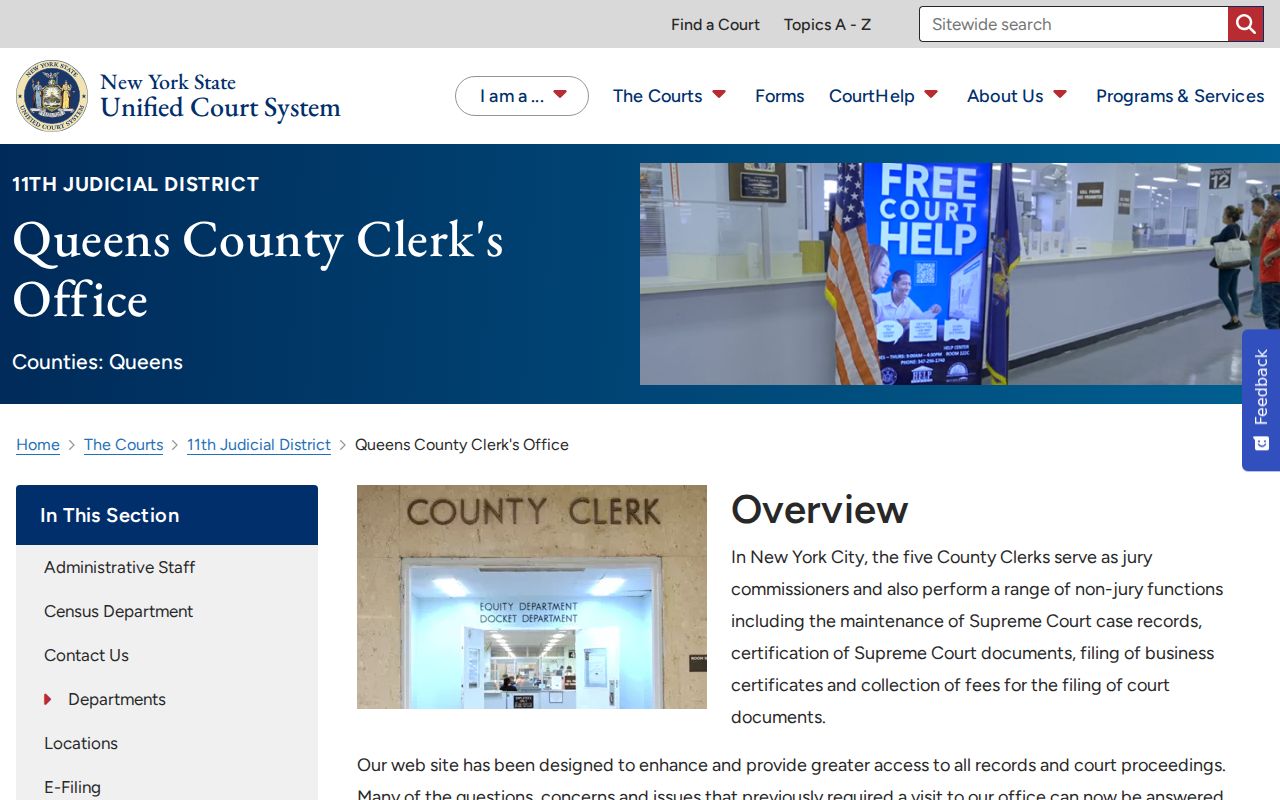
The clerk route is for a specific Queens case or certification question, not a broad name directory.
Queens Property Records: PIP and BBL
The NYC Property Information Portal is the practical first stop for a Queens address. It accepts an address, intersection or common place, BBL, borough and block, condo number, co-op development number, REUC identifier, air lot, and subterranean lot. Its parcel card can lead to an ACRIS link and tax-map or alteration-history routes. The portal does not make an official owner-name search the starting point, so use the address and parcel key first.
GOAT and ZoLa help when a Queens house number has a hyphen, a range, an old street name, or a confusing postal label. GOAT can return BBL, ZIP, census geography, precinct, community district, and council district. Those labels identify geography, not title. A PIP parcel result should be checked for borough, block, lot, address, and special condo or lot designation before any document search begins.
| Queens portal field | Use it for | Important limit |
|---|---|---|
| Address or intersection | Find a property starting point | Match the borough and street form |
| BBL or borough/block | Open a specific tax lot | A lot is not an occupant record |
| Condo, co-op, air, or subterranean lot | Reach specialized parcel forms | Confirm the property form first |
| ACRIS link | Move to recorded documents | Read the document image and date |
Use the Property Information Portal search choices to see the official entry routes before beginning a Queens residents directory address trail.
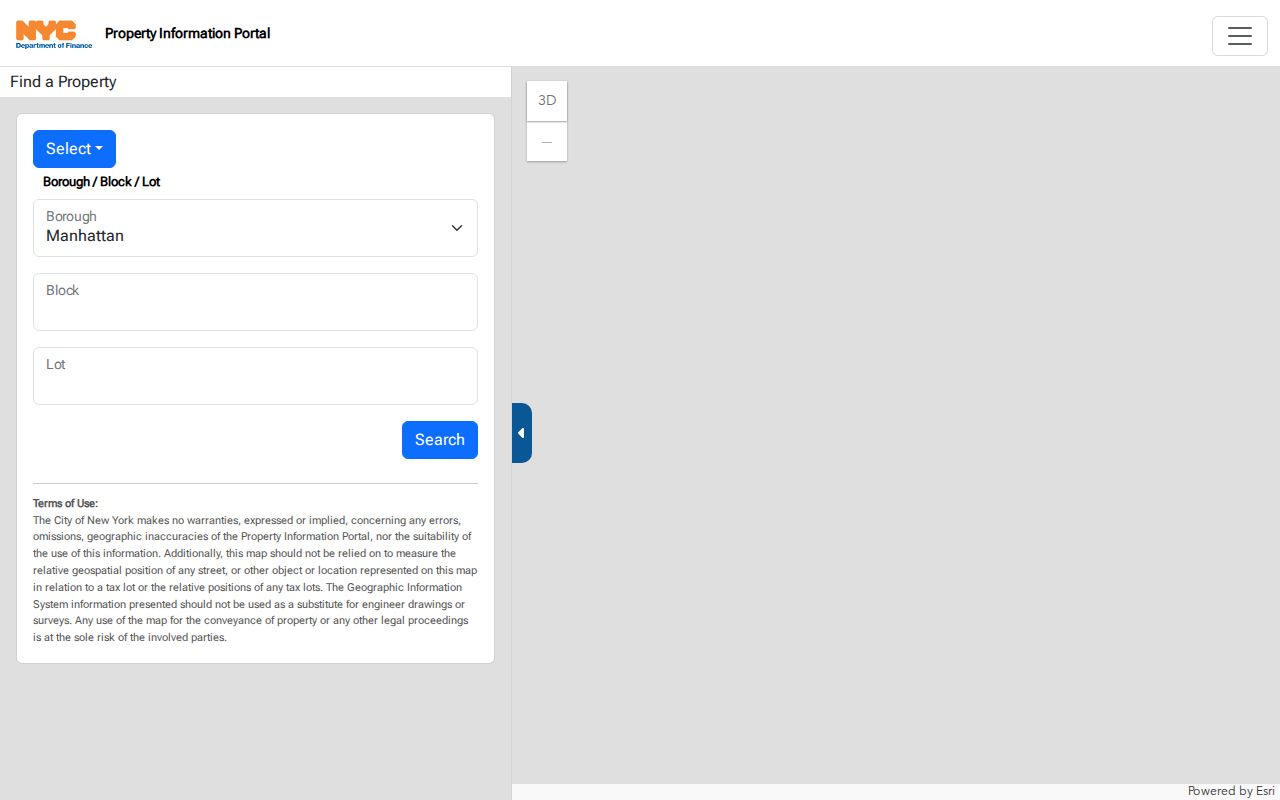
Once the Queens parcel key is stable, it can be carried to ACRIS or a map record without guessing from a surname alone.
- BBL
- The city identifier made from borough, block, and lot for a Queens tax lot.
- BIN
- A building identification number used in city building and geography systems.
- Parcel
- A tax-lot record that identifies property geography, not proof of who occupies it.
- Record index
- A finder record that points to an underlying document, volume, case, or image and has its own limits.
- Resident roll
- A custodian's list for a specific public purpose, such as the BOE registration system, not a universal household list.
- Criss-cross directory
- A historical reverse or street-order directory section that can connect an address and a surname when the volume includes it.
Queens ACRIS Records Begin in 1966
ACRIS is Queens's recorded-document index for 1966 to the present. It offers party-name, parcel, document-type, document ID or CRFN, transaction, reel/page, UCC, and federal-lien searches. A useful Queens search begins with the legal row for the BBL and street, then the master row for document type and date, then party rows for the roles and stated mailing details. The related document image and cross-reference tab resolve far more than a name hit alone.
The ACRIS party address is a mailing field. It is not automatically the property situs, and a grantee is not automatically a present resident. The result view can show borough, block, reel/page or file, CRFN, lot, document type, document date, recorded date, page count, party fields, remarks, and amount. That makes it a strong document trail but a poor shortcut to a general Queens residents directory.
Land records before 1966 are not online in ACRIS. The City Register directs researchers to the Land Records Research Library at the Queens City Register office, 144-06 94th Avenue. Bring a party name, BBL, document type, CRFN, transaction ID, or reel/page when available. Certified copies use a separate City Register process and may be mailed or picked up rather than emailed.
Note: The ACRIS index is a starting record, so confirm the image, document class, and recording date before relying on a party or address field.
Queens Voter Status Uses Exact BOE Fields
The NYC Board of Elections Am I Registered? form is a narrow confirmation tool, not a public name directory. It requires first name, last name, birth date in month/day/year form, borough, and ZIP code. The form returns a registration status or a record-not-found message. A mismatch can come from the date, ZIP, borough, spelling, an inactive or moved record, or routine list maintenance. It does not prove that someone never lived in Queens.
New York Election Law sections 3-220 and 5-602 set different rules for registration records and inspection. The law protects driver-license, non-driver-ID, Social Security, and facsimile information. Public lists can be arranged by election district and street/number or alphabetically, but the current Queens inspection or copy procedure should be confirmed with the Board of Elections rather than inferred from the five-field form.
Use the official Queens voter-status form only when the exact identifiers are appropriate for the question.
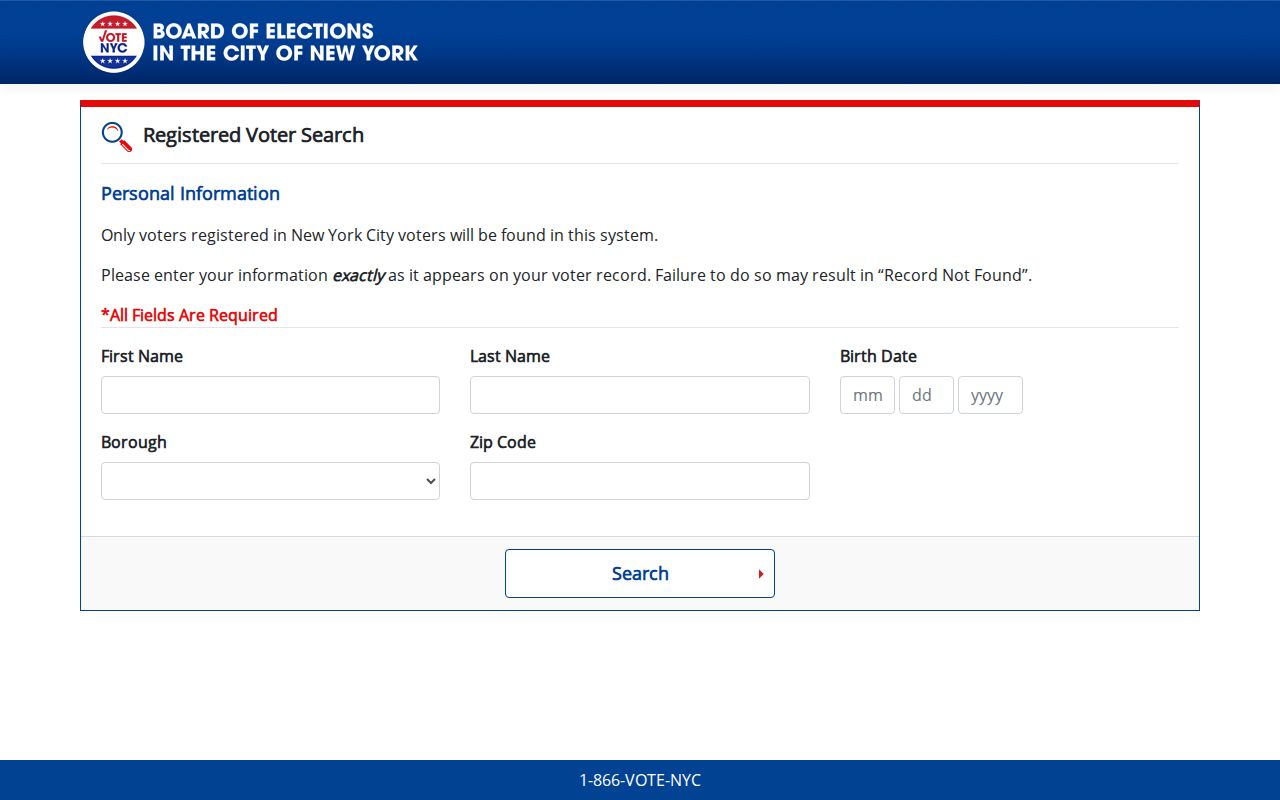
The required fields show why a Queens voter-status result should be treated as precise confirmation, not as a broad people search.
Current Queens Resident Directory Sources
Current Queens records are useful when their stated scope matches the question. A property portal supplies a parcel key. ACRIS supplies parties to recorded instruments. BOE confirms an exact registration-status inquiry. eCourts supplies public case indexes by court and filters. None of these sources alone identifies every person connected to an address, and each has its own redactions and update timing.
| Queens source | What it can show | Custodian | Access boundary |
|---|---|---|---|
| Property Information Portal | Parcel, BBL, tax-map and related-property details | NYC Department of Finance | Property key, not title proof |
| ACRIS | Parties and details in recorded documents | NYC City Register | 1966-present online |
| Am I Registered? | Exact voter-registration status | NYC Board of Elections | Five required matching fields |
| WebCivil | Public civil party and case index details | NYS Unified Court System | Selected public records only |
| NYSED verification | License number, profession, status, and update context | NYS Education Department | Official license record only |
For a one-person question, keep two independent keys, such as a court and year, or a BBL and recording date. The separate resident-lookup route is strongest when the result has a source-specific identifier rather than a same-name guess.
| Official Queens record path | Commercial people-finder category |
|---|---|
| Names the custodian, record class, access rule, and stated update boundary. | May combine data from different sources with its own cost, update cycle, and coverage limits. |
| Lets a reader inspect the underlying portal, document, volume, or request procedure. | Can be a lead only; confirm any claimed match with the responsible public custodian. |
| Keeps a party field, parcel, court role, or historical entry in its original context. | Should not replace the source date, record key, or access restriction of the original record. |
Queens Court Records Need a Case Key
The NYS eCourts entry point divides searches by court and case type. WebCivil Local accepts index, party, attorney, and judge searches with court, case-type, filing-year, status, future-appearance, and sort controls. WebCivil Supreme adds name, justice, and party-role choices. Record the Queens court selected, the year and status filters, and the returned index number. A party name by itself is not a reliable match.
WebCriminal, WebFamily, and WebSurrogate each have narrower coverage. Family matters are strongly restricted. WebSurrogate can search estate indexes by name, date of death, file number, old index, or index-book page; it says images after February 19, 2014 are online, while older images may be viewed at public computers. Sealed, restricted, or not-yet-entered matters can be absent. A no-match result is an access boundary, not a complete history.
The Queens County Clerk provides the court-record and certification fallback for Supreme matters. For a published decision or docket entry, retain the case name, court, index number, filing or decision date, procedural status, and official link. Leave out sensitive allegations and identifiers that are not needed to explain the records path.
Queens FOIL Requests Need a Narrow Scope
When a Queens agency has no public index, New York's Freedom of Information Law, Public Officers Law Article 6, is the request framework. Use NYC OpenRecords for most city-agency requests. Name the agency, the record type, a date range, the known location or identifier, and the preferred format. City OpenData should be checked first when an existing dataset can answer the question.
State guidance says an agency generally must grant, deny, or acknowledge a request within five business days. If it needs more time, it should give an approximate date; longer delays carry further notice expectations. A narrow request for an existing record is more workable than a request for an agency to build a new list or answer a broad research question. Copying guidance is commonly 25 cents per letter or legal page, while other media or search costs can differ.
FOIL does not override vital-record eligibility, court sealing, Address Confidentiality Program protection, or another statute. If access is denied or redacted, retain the cited exemption, the appeal route, and the date of the response. Request non-exempt portions where that is appropriate.
Historic Queens Resident Directory Shelves
For a former Queens household, the most useful source is often a dated city directory rather than a modern portal. The Queens city directory collections hold the detailed shelf and reading method. NYPL's digitized New York City directories span 1786 through 1934, while the Municipal Archives describes a 152-volume city-directory collection from 1837 through 1923. Queens-local and Trow runs add more focused borough and neighborhood leads.
A directory entry establishes that a name was printed at an address in a particular volume. It does not prove title, a family relationship, or current presence. Preserve the printed spelling, volume year, page, repository, and any uncertainty. Queens telephone directories, local library guides, maps, and archival collections can then test whether the address and street label hold across time.
Queens Records Before 1898 Need Old Place Names
New York City consolidation took effect on January 1, 1898. Earlier material may be cataloged under Long Island City, Newtown, Flushing, College Point, a town, or a village instead of Queens. A search that uses only the modern borough name can therefore miss a directory, certificate, map, or register. Keep the historic jurisdiction exactly as printed and add the current Queens label only as a research aid.
| Before 1898 | Search the town, village, or Long Island City label used by the source. |
|---|---|
| 1898 consolidation | Queens enters the modern citywide borough framework. |
| 1966 | Marks the online ACRIS boundary for Queens recorded documents. |
| Current archive work | Use borough, collection, series, and historic place name together. |
Final maps, Queens Public Library finding aids, and GOAT geography tools help translate old and current street labels. Jamaica Avenue's earlier Fulton Street name is a useful prompt to check the relevant map sheet, not a shortcut for every address.
Queens Resident Records Have Privacy Limits
Queens public availability is field-specific. Court interfaces omit sealed and other restricted matters. Vital records have relationship, identity, court-authority, or archival rules. DMV personal information is protected, and the Board of Elections excludes specific identifiers from released registration material. A public index result is a lead to verify, not permission to build a personal profile.
New York's Address Confidentiality Program gives eligible participants a substitute mailing address and mail forwarding. The actual address is protected except in specified law-enforcement or court processes. Do not try to reverse a substitute address. When a result is restricted, use the custodian's published secured channel instead of trying another public index.
Note: Record only the minimum facts needed, such as source, record type, date, official identifier, and a link to the custodian.
Queens Deed Alerts Follow a Parcel
Queens property registrants can use the free ACRIS Notice of Recorded Document alert for a property. Registration uses the property or BBL and contact and certification fields, with one property per registration. It can alert a registrant when a deed, deed-related, mortgage, or mortgage-related document records. Open the actual document or contact the Department of Finance after a notice arrives.
The alert is not a title guarantee and it does not establish fraud. In April 2026, the Mayor's Office announced a Deed Theft Prevention Office and said that more than 3,500 complaints had been received citywide from 2013 through 2023, primarily in Brooklyn and Queens. A complaint, notice, or indictment is a procedural event, not a final finding. The safest next step is to compare the BBL, document date, recording details, and official document image.
Queens Resident Records Need Local Context
A Queens address can carry several valid geographies at once: postal ZIP, community board, precinct, council district, census tract, tax lot, and historic town. NYC Planning resources and GOAT establish current geography, while the parcel portal supplies the BBL. The Queens County Clerk or eCourts supplies a case key. NYPL, the Municipal Archives, Queens Public Library, and the Queens Historical Society supply the historical layer.
The Queens Historical Society library collections include maps, atlases, family papers, photographs, rare books, genealogies, and ephemera across about 300 years, with research by appointment. Queens Public Library finding aids point to Sanborn and Belcher Hyde maps, cemetery maps, census enumeration maps, and final maps that can retain old and new street names. Call or schedule with the neighborhood, date range, address form, and desired collection ready.
Queens Records Change, So Date Every Result
City portals, court indexes, custody status, fees, office hours, ZIP assignments, and archival digitization all change. Save the source URL, the date checked, the exact search fields, result status, and source boundary. A useful negative-result note distinguishes not found, not public, not digitized, and not located in official sources. Those are different outcomes and lead to different follow-ups.
Queens records are expanding as well as changing. A 2025 city project announced digitization of historical records involving Queens, and the 2026 Newest New Yorkers report is current neighborhood context rather than person-level proof. Recheck an official collection or office before relying on an old capture. A dated, source-specific record trail is more reliable than a long unsourced list of names.