
Queens City Directory Collections and Years
Queens city directories are spread across several repositories, and each run has a different scope. The New York Public Library collection is the broadest digitized route, with New York City directories from 1786 through 1934. The NYC Municipal Archives has a 152-volume collection from 1837 through 1923, including general, business, residential, Queens, Richmond, and other borough series. The local record is strongest when the directory title, year, page, and repository are all noted together.
| Queens collection | Years located | Where held | Access route |
|---|---|---|---|
| NYPL New York City directories | 1786-1934 | NYPL Digital Collections | Search or browse online, then cite volume and page |
| NYC Municipal Archives directory set | 1837-1923 | Municipal Archives | Collection guide; some items can be unprocessed or restricted |
| Queens-local and Trow trail | 1902-1912; 1903 and 1908-09 | NY State Library and participating libraries | Verify the volume, holding, and scan for each year |
| Queens Borough City Directory | 1933 | Repository copy or scan varies | Later borough snapshot |
| New York telephone directories | 1927-1974 | Library microform trail | Address and telephone continuity only |
| 1915 Queens census index | 1915 | New York State Library guide | Pointer to the underlying census |
The gaps matter as much as the dates. A missing year can mean a different series, a physical-only volume, a catalog gap, a changed place name, or an unscanned item. City directories are annual or periodic publications, not a continuous census. Treat every Queens volume as a separate dated source.
Queens City Directories at NYPL
The NYPL New York City directories collection holds more than a Queens-only shelf. It includes residents, businesses, churches, schools, police, courts, government offices, and associated people across the citywide series. Search with the borough, neighborhood, street, and year in mind. A name that does not surface under Queens may appear under Long Island City, Flushing, Jamaica, or another historic place label.
For a household trail, record the volume year and page before transcribing anything. The scanned page controls over a search result or an extracted dataset. NYPL's Gateway to North America also offers text-searchable 1789-1914 New-York Historical Society material, including directories, member lists, maps, burial records, and gazetteers. It can help test a spelling or address variant, but the original image or volume remains the evidence.
Open NYPL's digitized directory collection to search or browse the citywide volumes.
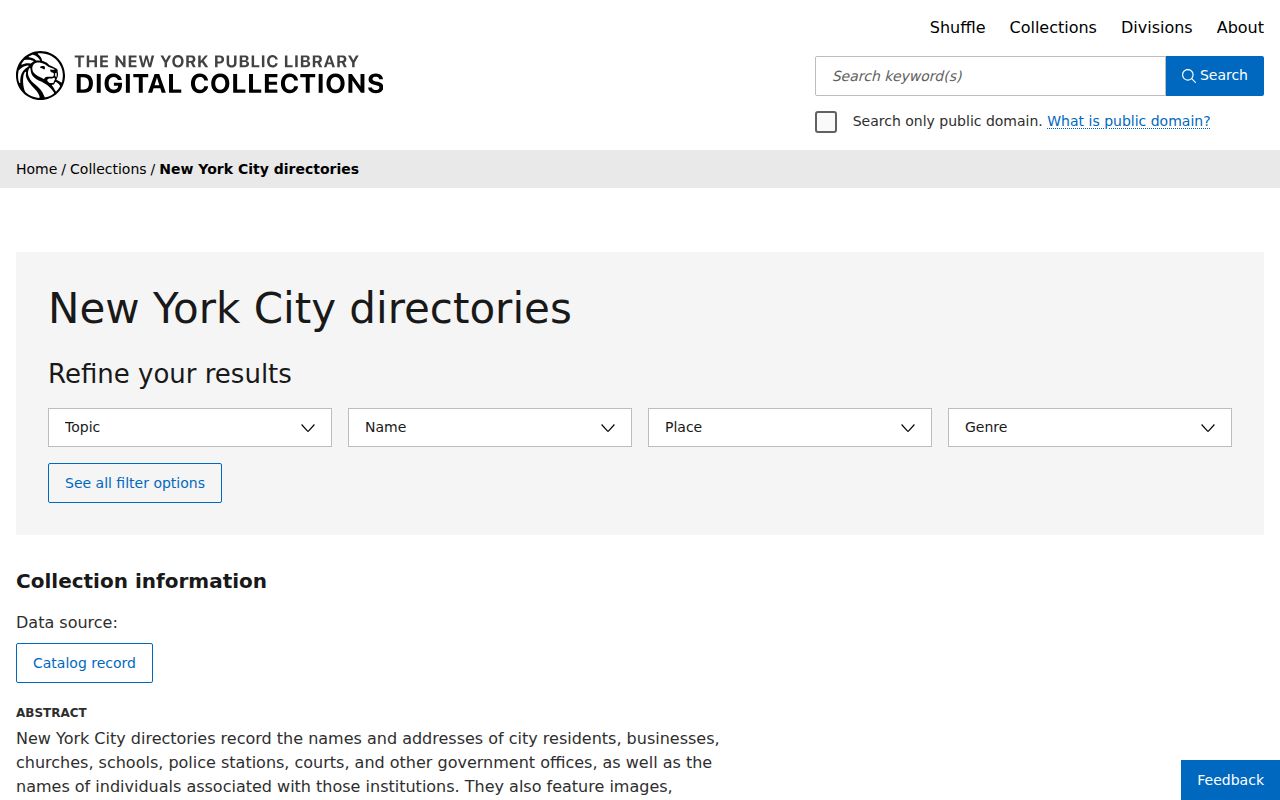
The collection display is a route into individual volumes; a Queens conclusion still needs the page, year, and printed place label from the item itself.
Queens City Directory Holdings at the Archives
The NYC Municipal Archives directory guide describes 152 volumes occupying 18.5 cubic feet from 1837 through 1923. Its holdings include Trow's General directories, Brooklyn material, Bronx and Manhattan material, business and residential Queens and Richmond series, and other directory types. Some material is unprocessed or subject to physical or privacy restrictions. That makes the collection guide a planning tool as well as a shelf description.
The archive route is especially useful when an online city-directory search stops at a wrong borough or a missing year. Ask for the collection, year range, historic place label, surname spelling, and address form. A Queens archive question can also lead to assessed valuations, tax assessments, assessment maps, historical vital material, or census resources, but each series has its own access rule and time span.
Research by a citywide title alone can blur the borough. Mark whether the entry came from a general, business, residential, telephone, institutional, or Queens-specific section. That label explains what the printed entry was designed to capture.
Queens City Directory Context at QHS
When a Queens city directory supplies a name and street but little context, local repositories can explain the block without turning the result into a personal dossier. The Queens Historical Society holds maps, atlases, manuscripts, photographs, family papers, rare books, genealogies, and ephemera across about 300 years. Research is by appointment, so prepare the neighborhood, address form, date range, and collection type before asking for help.
Queens Public Library finding aids add final maps, Sanborn and Belcher Hyde maps, cemetery maps, and census enumeration maps. Final maps for Queens from 1901 through 1953 can preserve old and new street names plus street location, grade, width, and length. Sanborn sheets add a dated view of a building's footprint, materials, use, and address. A map helps test the directory's place label, but it does not identify a household by itself.
Use the Queens Historical Society library page to prepare for an appointment and identify the collections that may complement a directory year.
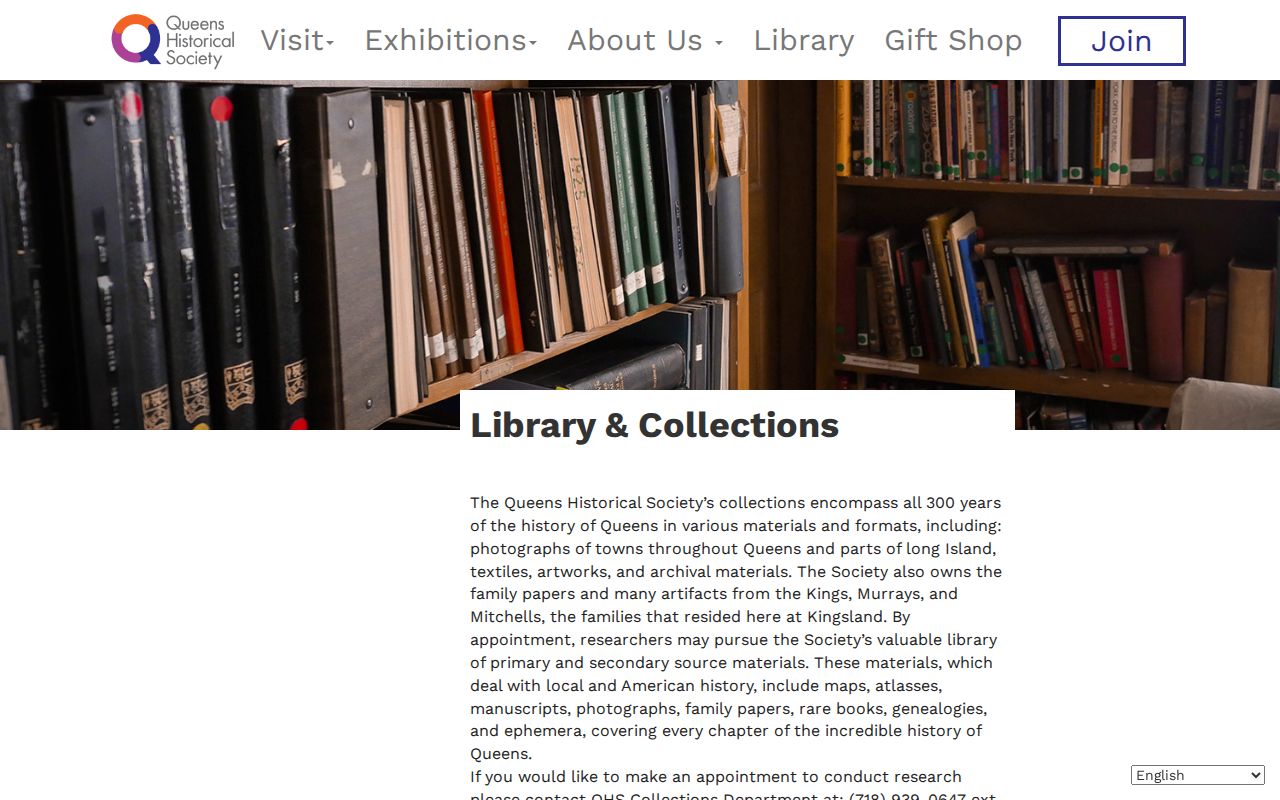
Appointment-based collections supply local maps and manuscripts that can clarify a Queens directory entry while retaining the source's time and access limits.
Reading a Queens City Directory Entry
A Queens city directory entry should be copied as a printed historical statement, not modernized into a biography. Start with the publisher or title, volume year, page, name exactly as printed, and address. Then capture any historical field that helps distinguish the listing, such as a spouse, occupation, business or household marker, cross-reference, and nearby entries. If a character is unclear in an image, use brackets or note the uncertainty rather than silently correcting it.
| Title and year | Identifies the directory run and its date. |
|---|---|
| Page | Lets another researcher check the printed entry and its neighbors. |
| Name as printed | Preserve initials, spelling, and abbreviations from the volume. |
| Address | Shows the printed address label for that publication, not a current location. |
| Household or business marker | Explains the entry's editorial category, if the volume includes one. |
| Nearby entries | Can help distinguish same-name listings or identify a local institution. |
- Criss-cross directory
- A reverse or street-order section used to move between address and surname entries where that volume provides one.
- Householder index
- An index arranged around a household or address reference rather than a complete family relationship statement.
- Abbreviation key
- The volume's own explanation of shorthand. Photograph or note it before interpreting a mark.
The useful reading order is title and year, page, printed name, address, and the volume's own key. That sequence preserves what the Queens entry actually says while leaving room for a later map, census, or archive source to confirm a separate fact.
Queens City Directories Across the 1898 Change
New York City consolidation took effect on January 1, 1898. Before that date, a historical Queens question may be filed under Long Island City, Newtown, Flushing, College Point, a town, or a village. The modern borough label is useful for orientation, but the original place name is the key for reproducing a directory or archive search. A pre-1898 no-result can be an indexing mismatch rather than proof that the household was absent.
| Pre-1898 | Use the town, village, or Long Island City label printed in the source. |
|---|---|
| 1898 | Consolidation changes the governing borough and citywide record framework. |
| 1902-1912 | Queens-local directory runs appear in the identified library trail. |
| 1933 | The Queens Borough City Directory supplies a later snapshot. |
| 1927-1974 | Telephone directories provide a further address-continuity trail. |
Street labels also change. Queens library material notes Jamaica Avenue's earlier Fulton Street name as a reason to consult the relevant final-map sheet. Use the historical label printed by the directory and compare it against the map date. Do not assume that every house number or street name stayed constant.
Queens City Directory Search Variants
Search a Queens city directory in more than one form. Begin with the exact surname and initial, then try spelling variants, abbreviated street suffixes, a former town or village, and the address without a modern assumption about house-number formatting. Queens names may be transliterated differently across a directory, newspaper, oral history, and current record. Preserve the form found in the original volume rather than choosing a preferred modern spelling.
A same-name entry needs a second historical key. Use the street, nearby entry, neighborhood institution, volume year, or map sheet. Compare at least two consecutive directory years and one address-oriented source when possible. A one-year disappearance may reflect a move, a missed volume, a publication lag, a changed listing category, or a transcription problem. It is not enough to declare that a person left Queens.
NY State Library guides also identify a 1915 Queens census index. Use that index as a pointer to the underlying census rather than as the record itself. The directory volume, census, map, and local repository each have a different purpose, so keep their facts separately cited.
Tracing Queens Families Through Directory Years
Family-history work with Queens city directories is strongest as a year-by-year trail. Start with a known address or name in one volume, then test the years on both sides. Save the location within the book and the relevant map or census reference at each change. This makes moves, repeat listings, spelling shifts, and uncertain gaps visible instead of forcing a smooth story from disconnected entries.
- Locate the first reliable Queens entry and save the title, year, page, and printed name.
- Check the next available directory years, noting address changes and the exact form of the name.
- Use a reverse or criss-cross section where available to test the address and surrounding entries.
- Pair the directory years with the relevant census period, keeping the census as a separate source.
- Use QPL maps, QHS collections, or archive finding aids to test an old street name, neighborhood, or institution.
A printed address can be a useful historical clue, but it does not carry forward automatically to a current resident. When the trail reaches a property question, use the separate current street-record path and begin again with the official BBL and document-date keys.
Queens City Directory Evidence Has Limits
Queens city directories are selective publications. They can miss people, delay a move, use a business address, retain an old street label, or vary between residential and business sections. Telephone listings do not prove residence. A directory's editorial choice, an unreadable scan, and an unprocessed archive volume are all normal source limits. State what the item actually shows: a printed name, address label, and date in a named volume.
Use a lawful, specific question and minimize personal details. A dated directory page plus a map or archive record is safer historical corroboration than matching an old entry to a modern person. If a record is restricted, protected, or unnecessary to the question, stop there. The value of the Queens city directory trail is reproducible context, not a new list of personal data.
Note: Retain the repository, source URL, volume, page, year, search spelling, and access date so another researcher can repeat the search.