
Queens Previous Residents Sources
Previous residents in Queens leave different kinds of dated evidence. A deed identifies parties to a recorded transfer, not necessarily the people who occupied the address. A directory prints a name and address in a particular volume, while a map explains a street label, lot, or building at a moment in time. Start with the most recent, well-identified parcel record and work backward. Keep the current address, any older spelling, BBL, document number, and source date together.
| Source | Years It Covers | Where Held | What It Shows |
|---|---|---|---|
| ACRIS | 1966 to present | NYC City Register | Recorded document, BBL, parties, dates |
| City Register research library | Before 1966 and other offline needs | Queens City Register | Older land-record index and research route |
| NYPL directories | 1786–1934 | Digital collections | Dated printed name and address |
| Municipal Archives directories | 1837–1923 | NYC Municipal Archives | Original city and borough volumes |
| Queens maps and collections | Varies by collection | QPL and QHS | Street change, footprint, local context |
For a recent transfer, start with a BBL and ACRIS. For an older household question, use a dated directory volume, then pair it with a map or census pointer. The NYPL directory collection is citywide, so retain the borough or neighborhood context and the volume and page. Queens local history can add an earlier street label or neighborhood clue without replacing the recorded chain.
Queens Previous Residents Start With BBL
A Queens address needs normalization before a backward search. Preserve the original spelling, then test hyphenated house numbers, range or unit forms, directional street names, and older neighborhood labels. Use the NYC Property Information Portal or GOAT and Planning resources to identify the borough, block, lot, and, where available, the BIN and local geography. Confirm that the parcel is in Queens before opening a deed trail.
BBL means borough, block, and lot. It is the parcel identifier that joins the map and property record to ACRIS legal and document rows. An address can be a range, a condo unit, an air lot, or a mailing location. That is why the BBL is a more stable bridge for Queens previous residents research than a street string alone.
- BBL
- A NYC tax-lot identifier made from borough, block, and lot.
- CRFN
- The City Register file number assigned to a recorded document.
- Situs address
- The location of the property itself, which can differ from a party’s mailing address.
Queens Previous Residents ACRIS Trail
ACRIS supports party-name, parcel, document-type, document-ID, transaction, and reel/page searches for Queens and the other city boroughs within its 1966-present scope. For a deed trail, the useful joins are legal information for BBL, street, and unit; master information for document ID, CRFN, type, date, and recording; and party information for the recorded names and party type. The party mailing address is not automatically the property address or proof of occupancy.
Use document-type filters so a deed is not confused with a mortgage, assignment, satisfaction, correction, or related instrument. A transaction can contain several documents. Read the document image and cross-reference information before adding it to the chain. A date signed and a date recorded are different fields, and a listed amount does not by itself establish market value.
The ACRIS search help illustrates the result controls used to move from a parcel or party query to a specific recorded instrument.
Each result should become one line in a research log, with the BBL, CRFN, instrument type, document and recording dates, parties, and the next query to test.
Trace Queens Past Owners by Deed
Follow the Queens deed trail one instrument at a time: PIP or GOAT, then BBL, then ACRIS. The current grantee on a conveyance is the buyer, while the grantor is the seller. To locate the seller’s earlier acquisition, search the same BBL and that person or entity in the role shown on the next candidate instrument. Accept the connection only when the legal description, lot history, date order, and document image support it. A shared surname or a similar street cannot bridge a gap.
- Find the parcel in PIP or GOAT and record its Queens BBL, address form, unit information, and current map context.
- Search ACRIS by the BBL and a recent deed-like document type. Open the newest candidate and record its CRFN, parties, document date, recording date, and image link.
- Use the seller, purchaser, and same BBL to locate the next earlier transfer. Check corrections, cross-references, partial-lot flags, and related instruments before continuing.
- Repeat backward only after each instrument’s legal description and sequence agree. Keep old and new lot numbers when a parcel split or consolidation appears.
- At the online boundary, take the BBL, historic address, dates, party spellings, and later CRFN to the City Register research route instead of guessing.
- Grantor and grantee
- The party transferring an interest and the party receiving it in a recorded instrument.
- Chain of title
- The documented sequence of transfers for a particular property interest, not a list of everyone who lived there.
- Legal description
- The BBL, lot, unit, rights, or other property wording in the record. It is often more reliable than a historic street address.
Note: ACRIS records a document relationship to a parcel, not a complete story of a household or an unbroken title conclusion.
Queens Previous Residents Before 1966
ACRIS is not the beginning of a Queens land trail. Its online property records begin in 1966. For an earlier link, use the City Register’s land-record research library at 144-06 94th Avenue in Jamaica. Bring a date range, party spelling, BBL, current and former street forms, and a known later CRFN. The research file did not locate a complete pre-1966 reel or volume list, so do not infer a missing grantor or grantee from the online gap.
The 1966 boundary changes the method. The City Register library is the fallback for older indexes, while historic maps and directories help translate the address around the gap. This is especially important for a lot that split, consolidated, carried an old street name, or was identified under a pre-consolidation place label. A record may use Long Island City, Flushing, Jamaica, or another town or village name rather than “Queens.”
Ask the records staff which index, reel, ledger, or copy route is available for the selected date range. Retain every office response with the search notes. An unavailable image, an unindexed volume, and a failed party search are different outcomes, and each points to a different next step.
Queens Previous Residents Map Checks
When the address changes or a transfer trail pauses, maps are corroboration tools. Queens Historical Society is an appointment-based local collection with maps, atlases, manuscripts, family papers, photographs, and rare books. Queens Public Library finding aids describe final maps, Sanborn and Belcher Hyde maps, cemetery maps, and census enumeration maps. The Library of Congress provides digitized Queens Sanborn map volumes.
Final maps can preserve old and new street names as well as street dimensions. Sanborn sheets can show a footprint, materials, use, address, and map year. Neither makes a person-level claim. Use a map to explain why a street number, lot shape, or block label changed, then return to the recorded instrument or dated directory to test the household question.
Queens Previous Residents Household Trail
Ownership is only one part of who lived here before. A city directory is a dated printed snapshot, not a title record or a current-residence claim. Search a surname, initials, spelling variants, street abbreviations, and the historic place label. Pair at least two consecutive directory years with a reverse or address source when available. The Queens city directory collections hold the fuller directory and repository details; use them here to test a particular address trail rather than to repeat a whole collection list.
- Keep the address form used in the directory and its volume, year, and page.
- Compare the same address in a nearby directory year, then note whether the listing is residential, business, telephone, or another section.
- Use the NY State Library’s 1915 Queens census index as a pointer, then check the underlying census source or volume.
- Add a final-map or Sanborn sheet to check old names, renumbering, lot changes, and the period’s block geometry.
Obituaries, cemetery material, and probate indexes can provide an endpoint after a dated address trail, but each has its own scope. WebSurrogate supports estate-index searches subject to its image and confidentiality rules. Preserve the official file number or archive citation and avoid treating a name coincidence as a family relationship.
Lawful use. Queens previous residents research is for house history, family history, estate work, and personal curiosity. Do not use these records to harass, track, or expose a living person.
Queens Previous Residents Deed Notices
For a current property record, the free ACRIS Notice of Recorded Document service is a useful separate check. Registration accepts a borough and street address, or a BBL, with a unit for a condominium where required. It asks for the registrant’s interest, contact details, and a certification. One property is registered at a time, and notices generally arrive the day after recording. A notice is not proof of fraud or a title guarantee.
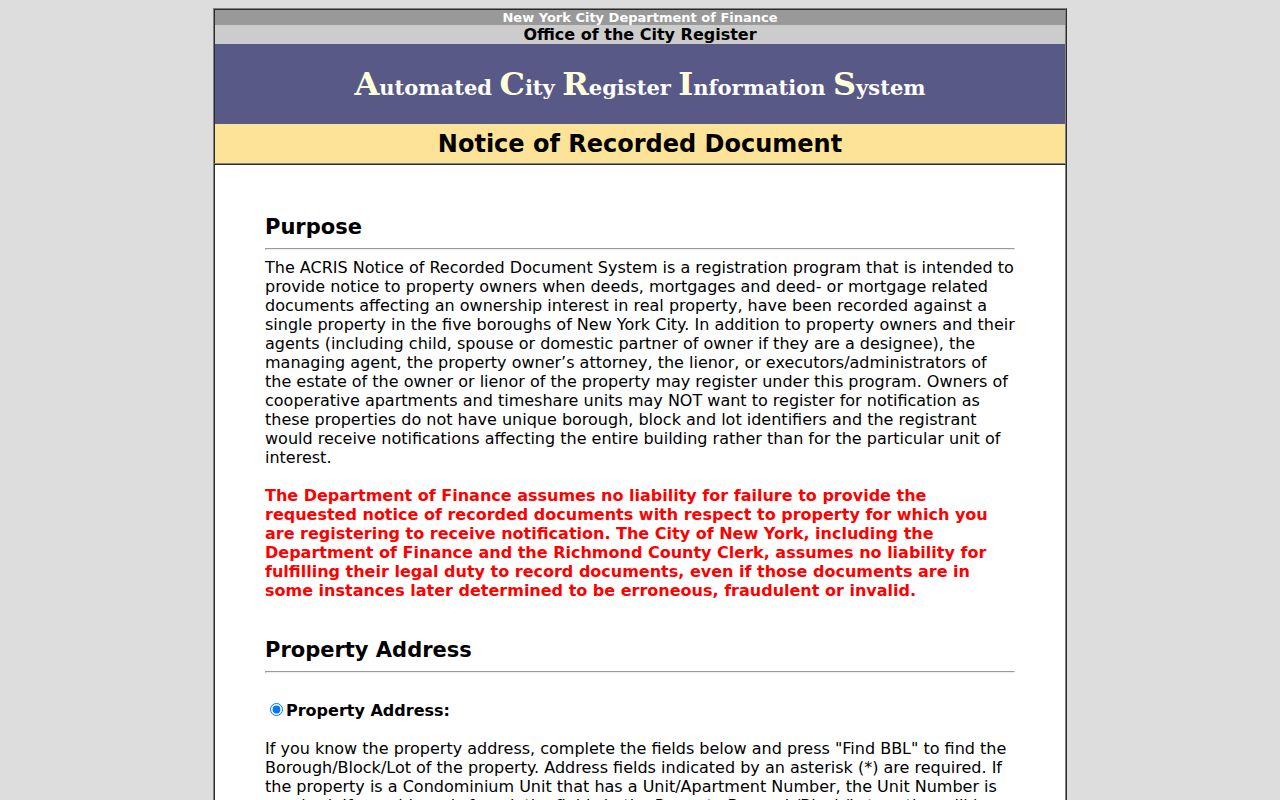
The alert can prompt a timely review of the recorded document. Open the official record and contact the proper City agency if its details do not match the property history you have documented.