
Queens Resident Lookup Records
A resident lookup in Queens is a verification task, not a broad name search. Choose the record that fits the question. The Board of Elections can confirm a registration status when all of its required fields match. Court indexes can identify a public case role and status. ACRIS can place a party in a recorded instrument when the borough, block, lot, and date line up. Historical directories and vital indexes provide dated evidence, while a current certificate has stricter eligibility rules.
Keep the agency key beside every result. A court index number, a certificate number, a BBL, a document ID, or a directory volume and page gives the next office something specific to locate. A surname alone does not. The Queens County Clerk is the route for Supreme Court records and certification when an online civil result identifies a usable case key.
| Record | What It Confirms | Where to Search | Access |
|---|---|---|---|
| BOE registration | Status when five exact fields match | NYC BOE | Public confirmation form |
| Civil case index | Party role, court, index, status | NYS eCourts | Public subset |
| Recorded property party | Role in a dated document | ACRIS | Public index and images in scope |
| Vital record | Historical index or eligible certificate | Historical Vital Records | Varies by series and requester |
| Professional or entity row | Official status or credential | NYSED verification | Public lookup |
Start with the source that needs the fewest assumptions. A known case number belongs in eCourts. A known Queens address belongs in the Property Information Portal and ACRIS chain. A historic name and approximate year belongs in the archive index. For a current registration question, use the exact BOE form rather than trying to turn a public confirmation tool into a name directory.
Exact Keys for Queens Lookups
The NYC Board of Elections Am I Registered? tool requires five fields: First Name, Last Name, Birth Date in mm/dd/yyyy format, Borough, and ZIP Code. Queens is a required borough choice, not a detail that can be guessed from a mailing address. The form reports registration status or “Record Not Found.” It does not establish that a person currently occupies an address, voted, or belongs to a household.
A mismatch deserves a second check, not a conclusion. A move, an inactive record, a spelling variant, a date entry error, ZIP mismatch, or list-maintenance timing can all explain it. Election Law sections 3-220 and 5-602 provide public-record and inspection routes under board supervision, but specified identity fields remain excluded. For an address question, identify the election district through the BOE streetfinder and ask the Queens office what inspection or copy method is currently permitted.
Queens Resident Lookup Court Fields
WebCivil Local accepts index, party, attorney or judge routes, with court, case type, filing year, status, future-appearance, and sort controls. WebCivil Supreme uses index number, name, attorney, justice, role, court, year, status, future appearances, and sort. Both can return HTML or PDF. Their public displays omit sealed or otherwise restricted matters, so a no-match is not a complete history.
| Portal | Useful identifier | Boundary |
|---|---|---|
| WebCivil Local | Party, index, court, filing year | NYC local civil index |
| WebCivil Supreme | Name or index, role, selected court | Active and disposed Supreme civil matters |
| WebSurrogate | Decedent name, date, file or old index | Probate images have date and CPI limits |
Log the selected court, year setting, status setting, role, and index number. “All” status is broader than “Open,” while a future-appearances option is a calendar filter. The Queens County Clerk can handle the next permitted record or certification step after a Supreme index is identified.
Reading Queens Court Search Results
The WebCivil Local party-search form shows why a name needs a court and time boundary. Its filters distinguish a party search from an index, attorney, judge, or calendar search.
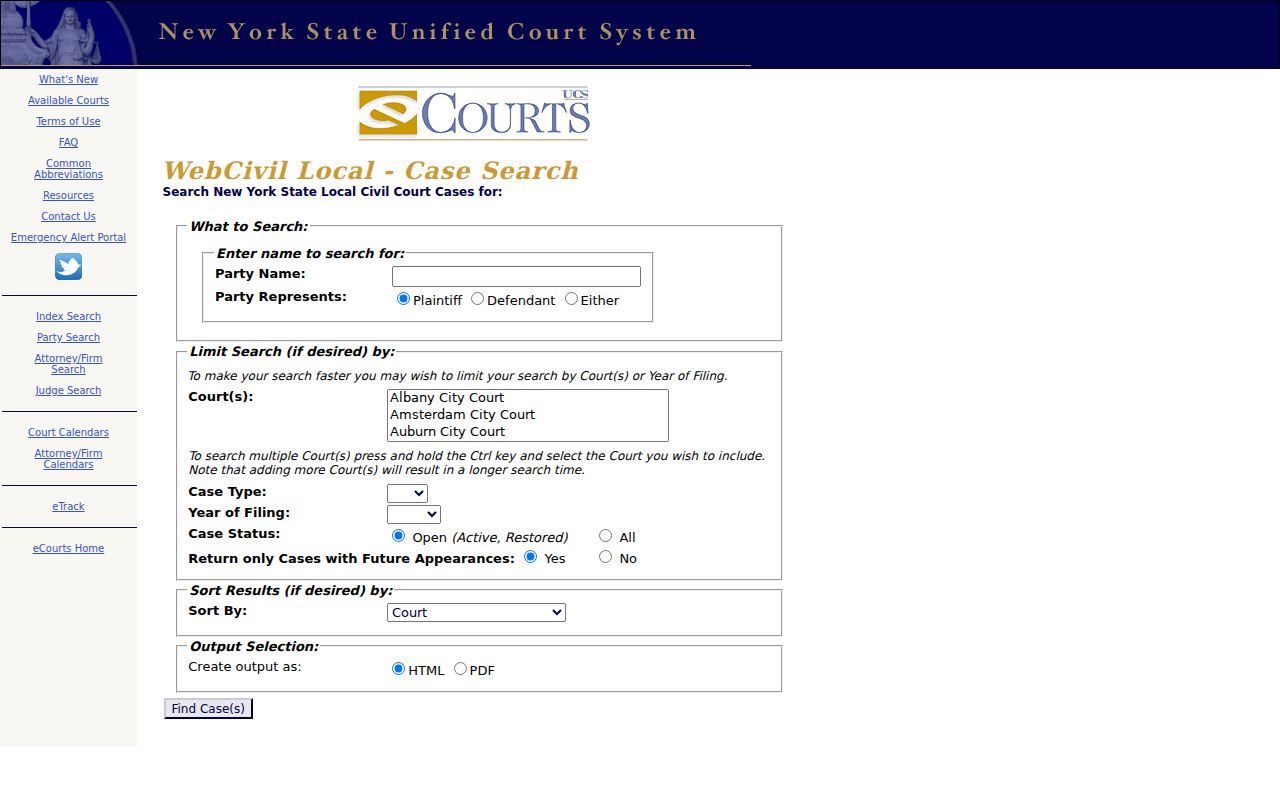
Use the displayed controls to narrow the official index, then preserve the resulting court, index number, date, role, and status instead of copying unnecessary personal details.
Verify Queens Resident Records
Use two independent keys before treating a result as a match. For a property-connected person, connect the name to a Queens BBL and recording date rather than relying on an ACRIS mailing address. For a court participant, retain the selected court, role, filing year, and index number. For a historical person, keep the directory or certificate year and repository. The evidence should answer one question at a time and preserve disagreements between sources.
- Use Property Information Portal or GOAT to normalize a Queens address and save its BBL.
- Open the related ACRIS record only after the borough, block, lot, and date agree. Note whether the name is grantor, grantee, or another party role.
- Search the appropriate WebCivil form with a court, year, role, and status filter. Record the index number and public status.
- For a historical life event, compare the archive index by certificate type, borough, year, and name. Request a copy only through the responsible custodian and eligibility route.
- Docket
- The court’s organized case record. A public index may show only part of it.
- Index versus image
- An index points to a record with fields such as a name or number. An image is the scanned document and can have separate access rules.
- Certified copy
- A copy issued by the custodian with its official certification. It is not the same as a search result or a download.
Where the second key fails, retain the result as unresolved. A common surname, a shared ZIP Code, or a similar street name is not enough to combine records.
Queens Resident Lookup Certificates
Queens vital work has three distinct routes. Current New York City birth and death certificates belong with NYC DOHMH or its death-certificate process. Applicants use the office’s online, mail, or in-person path and must meet the relationship, identity, or authority rules. Current material is not an ordinary Freedom of Information Law request. A short-form birth certificate, a standard death certificate, and a confidential medical-cause report are not interchangeable records.
For older material, the NYC Municipal Archives genealogy route and Historical Vital Records portal can search or browse by certificate type, name or certificate number, borough, and year range. Queens archive coverage includes births for 1898–1909, deaths for 1898–1948, and marriages for 1898–1949, with separate pre-consolidation town, village, and Long Island City material. An empty historical search can reflect an unreported event or an offline source, especially for early births.
| Need | Custodian | Key and limit |
|---|---|---|
| Current NYC birth or death | NYC DOHMH | Eligible requester, identity, application, fee |
| Historical Queens record | Municipal Archives / HVR | Certificate type, name or number, borough, year |
| Statewide divorce or statewide route | NYSDOH | Separate state process under Public Health Law §4174 |
Do not merge these systems into one certificate lookup. The current DOHMH route, archival scan or genealogy order, and statewide NYSDOH route have different requesters, identification requirements, and fees.
Queens Resident Lookup Mismatches
A missing BOE record, ZIP mismatch, or absent ACRIS party does not prove that someone never lived at an address. ACRIS begins with its own indexed scope and a recorded party can have a mailing address unrelated to the parcel. BOE requires exact fields and reflects registration administration, not a continuous residence history. Court search results can be absent because a record is sealed, restricted, not yet entered, or outside the selected court and year.
Write down the portal, date searched, spelling, borough, field settings, and result message. Then choose the next source based on the gap: a historic directory for a dated printed address, an archive index for an event, a BBL-based ACRIS search for a property link, or the custodian’s request process for a record not available online. This preserves a useful negative result without turning it into an identity claim.
Note: The best Queens verification record is the one whose fields match the question, date, jurisdiction, and access boundary.
Queens Resident Lookup Status Records
When the question is whether a person is named in an official professional or entity record, use the record that states the status. The NYSED Office of the Professions verification tool searches by profession and at least three last-name letters, or by a full license number. Its result can show a name, profession, license number, location, original license date, registration status, and listed discipline information. Older computerized entries can be incomplete, and spelling variants such as Mc or O forms deserve separate searches.
The New York Department of State entity database is different. It reports organization information such as current name, organization date, jurisdiction, county, service-of-process address, registered agent, and status for covered entities. A service address or entity role is not proof that a person lives in Queens. Treat either result as the agency’s stated record on its update date, then keep it separate from property, court, or voter evidence.
Limits on a Queens Resident Lookup
Public availability is field-specific. Court interfaces omit sealed, adoption, youthful-offender, Family Court, and other protected material. BOE records exclude driver-license, non-driver-ID, Social Security, and facsimile information. DMV personal information is protected and is not a Queens resident source. A public vital index can point to an archive item while a current certificate remains restricted to eligible requesters.
New York’s Address Confidentiality Program gives eligible participants a substitute mailing address and mail-forwarding service. The actual address is protected except through permitted legal processes. Do not try to reverse a substitute address or combine partial records to identify it. If a record seems incorrect, use the agency or custodian’s published correction or request route.
Lawful use. A Queens resident lookup can support personal, family-history, estate, or civic research. Do not use official records to stalk, harass, intimidate, or expose a protected person.